Wollongong’s growth from a small cedar‑getting outpost to a steel and coal powerhouse left a layered geological legacy. Between the sandstone cliffs of Mount Keira and the Tasman Sea, the city sits on a narrow coastal plain where Quaternary alluvium, residual soils, and colluvial fans meet. Any engineer working between Fairy Meadow and Dapto knows the drill log can change completely within fifty metres. Getting reliable SPT data here isn’t a tick‑box exercise — it’s the difference between a footing that settles a few millimetres and one that tilts after the first big storm. Our crew runs the Standard Penetration Test under AS 1726, recording blow counts and sample recovery with the care you’d expect from a team that’s logged hundreds of boreholes across the Illawarra. When the subsoil conditions get tricky, we often combine SPT profiling with a CPT sounding to pin down the transition between stiff residual clay and the underlying Hawkesbury Sandstone, giving structural engineers a continuous strength profile without gaps.
SPT N‑values in Wollongong can jump from single digits to refusal within two metres — don’t let a 1.5‑metre interval miss the layer that controls your foundation.
How we work
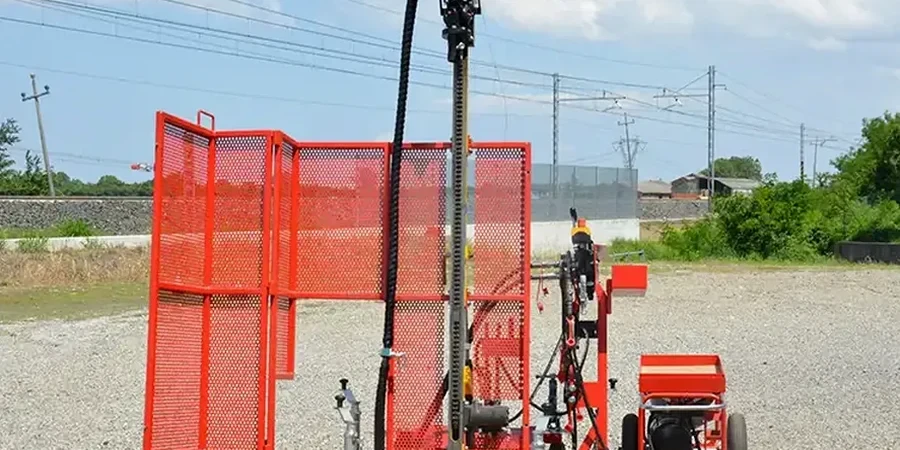
In Wollongong, one thing we see time and again is contractors surprised by how fast the ground stiffens once you cross the Bulli Pass formation. You can start a borehole in loose beach sand near Port Kembla and be into SPT N‑values above 50 within three metres. That’s why we never rely on a single test interval. Our SPT setup uses a safety hammer with an automatic trip, calibrated to deliver 60% of the theoretical free‑fall energy, so the N60 numbers you get are directly usable for bearing capacity calculations. We log every sample for colour, plasticity, and moisture, and we pay particular attention to the presence of coal wash and slag fill — remnants of the city’s industrial past that behave unpredictably under load. For sites near the escarpment where slope creep is a concern, we cross‑reference SPT refusal depths with mapped rockhead levels from the NSW Smooth Geology dataset, ensuring the pile socket length isn’t guessed but measured.
Site-specific factors
A nine‑storey residential project on Crown Street hit a lens of saturated loose sand at 4.5 metres — N‑values of 4 to 6 — directly above a stiff clay layer. The structural engineer had assumed a conservative bearing pressure of 150 kPa, but the SPT profile flagged a real liquefaction susceptibility under the design earthquake for a Class C site. We ran additional sampling, and the gradation curves confirmed poorly graded sand with less than 5% fines. That changed the foundation solution from a raft to driven piles, socketed into the residual profile below 10 metres. Skipping the SPT at that depth would have meant a foundation that looked fine on paper but had zero margin against excess pore pressure during a seismic event. In Wollongong, where the seismic hazard factor Z sits at 0.09 under AS 1170.4, ignoring the middle layers isn’t a risk — it’s a liability.
Quick answers
What does an SPT test cost for a typical Wollongong residential block?
For a standard single‑borehole SPT program on a residential lot, budget between AU$880 and AU$1.290. The final figure depends on access, depth to refusal, and whether we need to core into Hawkesbury Sandstone. Mobilisation across the Wollongong LGA is included in that range.
How deep do you drill the SPT in Wollongong’s escarpment suburbs?
It varies. In suburbs like Balgownie or Keiraville, we typically drill to 6–9 metres to pass through the colluvial mantle and hit competent rock. The borehole log dictates the final depth — we stop at SPT refusal (50 blows per 300 mm) and then core a minimum 1.5 metres into bedrock to confirm the socket material.
Can SPT data be used for retaining wall design under AS 4678?
Absolutely. We provide drained and undrained shear strength parameters derived from SPT correlations, which structural engineers can plug directly into their AS 4678 limit state calculations. For walls over 2 metres in the Wollongong city area, we also recommend a site‑specific groundwater assessment using the borehole we drill for the SPT.