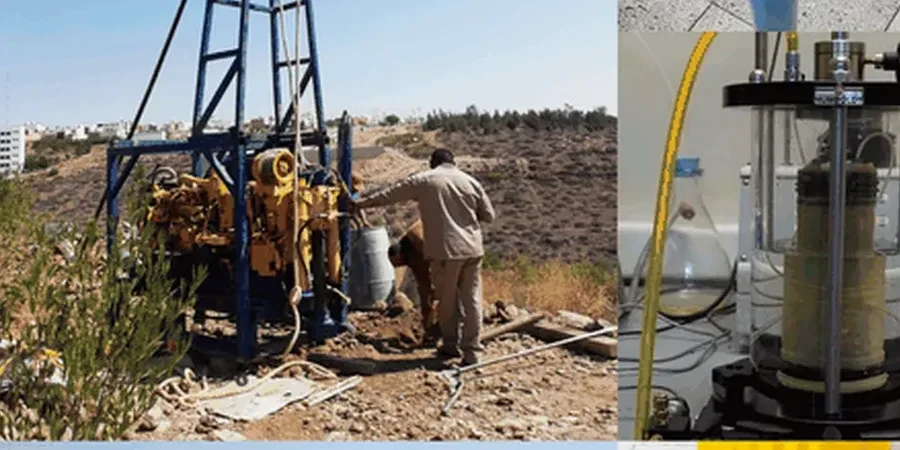
The Illawarra escarpment meets the sea at Wollongong and this collision of geology creates a ground profile that shifts dramatically within a few hundred metres. Colluvium from the steep slopes overlies residual siltstone and sandstone: the material is often unsaturated, with clast-supported fabric that drains fast but compresses erratically under load. A soil mechanics study here has to separate the influence of relic jointing from the mass behaviour of the matrix. Our laboratory processes that physical evidence: we consolidate specimens in incremental load steps, measure pore pressure response in triaxial cells, and derive the strength envelope that governs bearing capacity. Tunnelling and deep excavation projects near Crown Street or along the Princes Motorway corridor frequently encounter these transitional materials and the engineering assumptions need calibration against measured index properties. For large-scale earthworks we combine the soil mechanics program with in-situ permeability testing to capture the drainage boundary conditions that control consolidation time.
A Wollongong residual profile can lose up to 40% of its undrained shear strength when slickensided fabric is ignored in triaxial interpretation.
Quick answers
What is the typical turnaround for a full soil mechanics study in Wollongong?
For a program covering index tests, triaxial and oedometer consolidation, standard turnaround is 15-20 business days from sample receipt. Urgent single-parameter reports can be delivered in 7 business days. The timeline depends on consolidation stages: incremental loading oedometer tests run 5-7 days for the loading sequence alone.
How much does a soil mechanics study cost for a residential site in Wollongong?
A targeted program for a single-dwelling site in the Wollongong area typically ranges from AU$5.090 to AU$8.740, depending on the number of triaxial tests, oedometer stages, and whether undisturbed sampling from boreholes is included. The final scope is scoped after reviewing the preliminary site investigation data.
Do you test colluvial soils differently from residual soils?
Yes. Colluvium requires careful specimen preparation because large clasts must be excluded or the matrix tested separately. We often run remoulded direct shear at in-situ density for the matrix fraction and report the particle size distribution to quantify the clast proportion. For residual soils, undisturbed sampling is critical and we focus on preserving the in-situ fabric for triaxial testing.