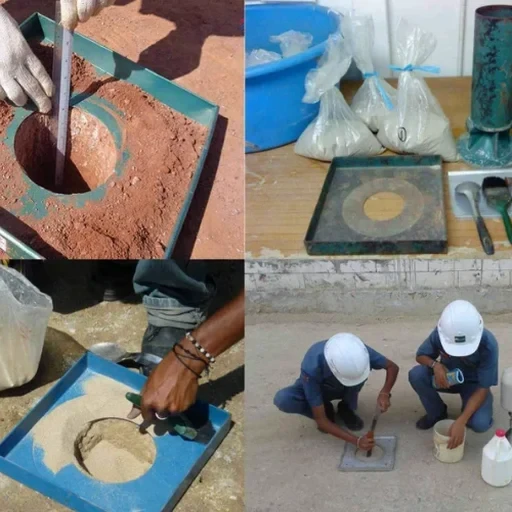
Wollongong’s construction boom, with over 220,000 residents and major infrastructure like the Port Kembla upgrades, has pushed earthworks into terrain where the Illawarra Escarpment meets coastal floodplains. The sand cone field density test remains the most direct way to verify compaction on these sites, and in our experience, no nuclear gauge reading replaces a properly executed calibration against a physical volume measurement. AS 1289.5.3.1 defines the procedure we apply daily across West Wollongong, Figtree, and the northern suburbs, where residual clay and colluvial fills require layer-by-layer control before slab pours or pavement construction. We often combine these tests with plate load testing when the structural engineer needs a deformation modulus alongside the achieved relative compaction—particularly on large warehouse slabs near the Port where differential settlement has been a known issue. The sand cone method, when done by an experienced operator who understands the local geology, gives you a result that stands up to both council inspection and the practical demands of the site.
A sand cone test done without rock correction on Wollongong’s gravelly colluvium can over-report compaction by 5 to 8 percent—enough to turn a compliant fill into a future settlement claim.
How we work
The kit we run on Wollongong sites is straightforward but unforgiving of shortcuts: a calibrated one-gallon sand jar, a steel base plate with a 165-mm diameter opening, and graded Ottawa sand that we density-check against our NATA-accredited reference every morning before heading out. The test involves hand-excavating a hole through the full lift thickness—typically 150 to 300 mm in local subdivision work—then measuring the excavated volume by backfilling with sand through a cone valve. Weight of material removed divided by volume gives the in-place wet density. We then oven-dry a representative sample to back-calculate dry density, and compare it against the maximum dry density from a standard or modified Proctor curve run in our lab. A common pitfall on Illawarra sites is gravel content above 20%, which forces a rock correction per AS 1289.5.4.2; without it, you will over-report compaction and risk underperformance in service. For deeper fill verification, particularly on the steeper blocks around Mount Keira, we also run test pits to visually log the fill profile and correlate it with the density data from each lift.
Quick answers
How much does a field density test cost in Wollongong?
For a standard sand cone test with a NATA-accredited report, the typical range is AU$140 to AU$260 per test, depending on how many tests are done on the same visit. We adjust pricing for volume—spreading the mobilisation cost across ten tests on one site brings the per-unit rate down noticeably compared to a single-test callout.
How many sand cone tests do I need for my site?
AS 3798 gives a frequency guideline of one test per 500 square metres per compacted layer, or one per 250 cubic metres of fill placed, whichever is reached first. On a typical Wollongong residential lot of 450 to 600 square metres with 300-mm lifts, that works out to roughly three to five tests per lift to give statistically meaningful coverage.
Does the sand cone method work on all soil types?
It works well on most materials encountered in the Illawarra, but it has limitations. Clean sands that collapse before you can measure the hole volume, and very coarse gravels where the excavation becomes irregular and the sand loss is hard to quantify, both reduce accuracy. In those cases we may recommend alternative methods or a combined approach with other test types.
What is the difference between standard and modified Proctor?
The difference is the compactive effort applied in the laboratory. Standard Proctor uses a 2.7 kg hammer dropping 300 mm in three layers; modified Proctor uses a 4.9 kg hammer dropping 450 mm in five layers. The modified test compacts the soil more densely and is the reference most commonly specified for engineered fills under roads and industrial slabs in the Wollongong area.